A Foundation for Music Theory that Actually Explains Why
The tonal structure of Western music is two-dimensional. The piano hides this. Standard notation encodes it. PitchGrid reveals it.
Explore this interactively with the PitchGrid Plugin
VST3 · AU · CLAP Note Effect for macOS & Windows · full features in the trial, no card · 42 €/$/£ perpetual license · PitchGrid Mapper is free
You already learned two-dimensional music theory. You just couldn't see it.
The notation is 2D — scale degrees on one axis, accidentals on the other. Chord relationships are 2D. Voice leading rules are 2D. The stack-of-fifths construction that gave us the diatonic scale, known since Babylonian times, is intrinsically 2D.
But the piano keyboard is one-dimensional. So you learned to think in 1D, projecting everything down onto a line.
PitchGrid unfolds that projection. What felt like arbitrary rules suddenly makes geometric sense. Modes, keys, transposition, counterpoint — they all still work, but now you can see why.
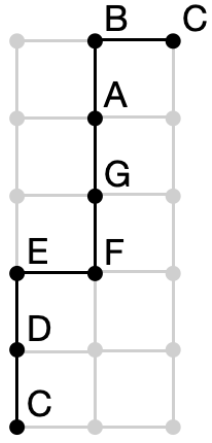
Bach's famous B–A–C–H motif? It's a sequential walk through a generalized scale mapped into Western pitch space — a structure he may have intuited three centuries before anyone had the math to describe it.
Something Was Always Missing
If you've ever felt that music theory explains the what but not the why — you were right.
The Missing Piece
Music theory teaches you rules — but rarely explains where they come from. Why seven notes? Why do key changes work? Why does a chord shape mean the same thing in every key? And why do we need two different names — G♭ and F♯ — for what sounds like the same note?
These aren't arbitrary conventions. They're consequences of a two-dimensional structure that's been hiding in plain sight since Pythagoras — obscured when the piano folded it onto a line.
PitchGrid unfolds it back. Not new theory — the missing chapter of existing theory.
See It. Play It.
Two tools that work as one — connecting eyes, fingers, and ears to scales that were previously inaccessible.
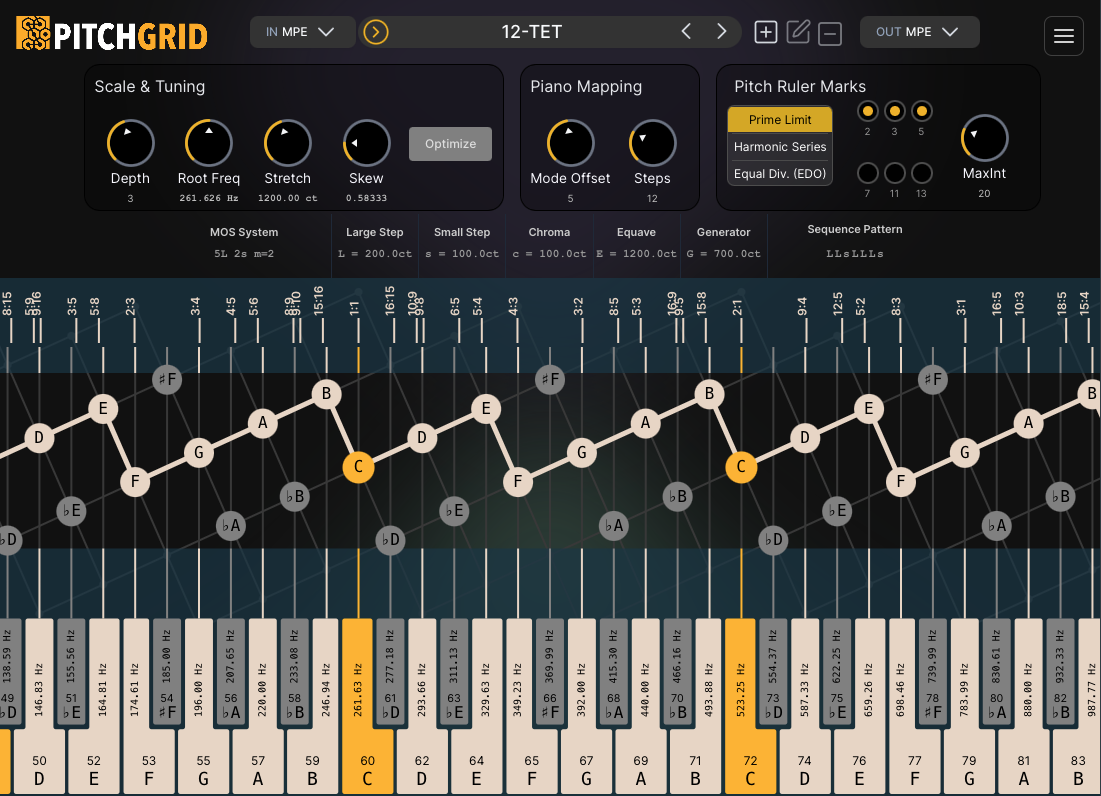
 PitchGrid Plugin
See the tuning. The plugin opens a window into an infinite 2D lattice of pitches. Turn knobs to explore — watch intervals shift, find the sweet spots where ratios align. Modes, transposition, chord relationships: they all still work. Maps to the piano keyboard and DAW piano roll — bridging new tunings with your existing tools.
Get the Plugin User Manual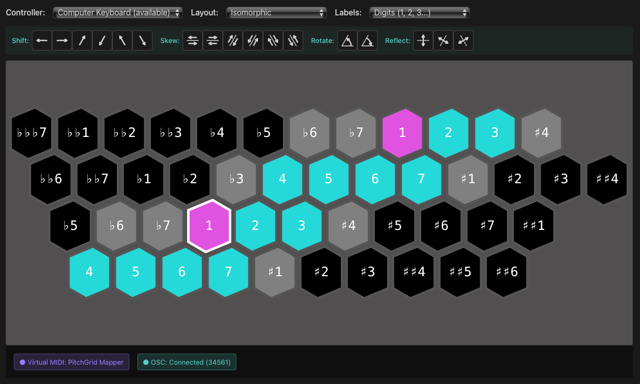
 PitchGrid Mapper
Play the tuning. The Mapper lays out any scale on your 2D controller so the geometry matches the music. Same shape = same interval, anywhere on the grid. Your hands learn what your ears hear.
Download Mapper Learn More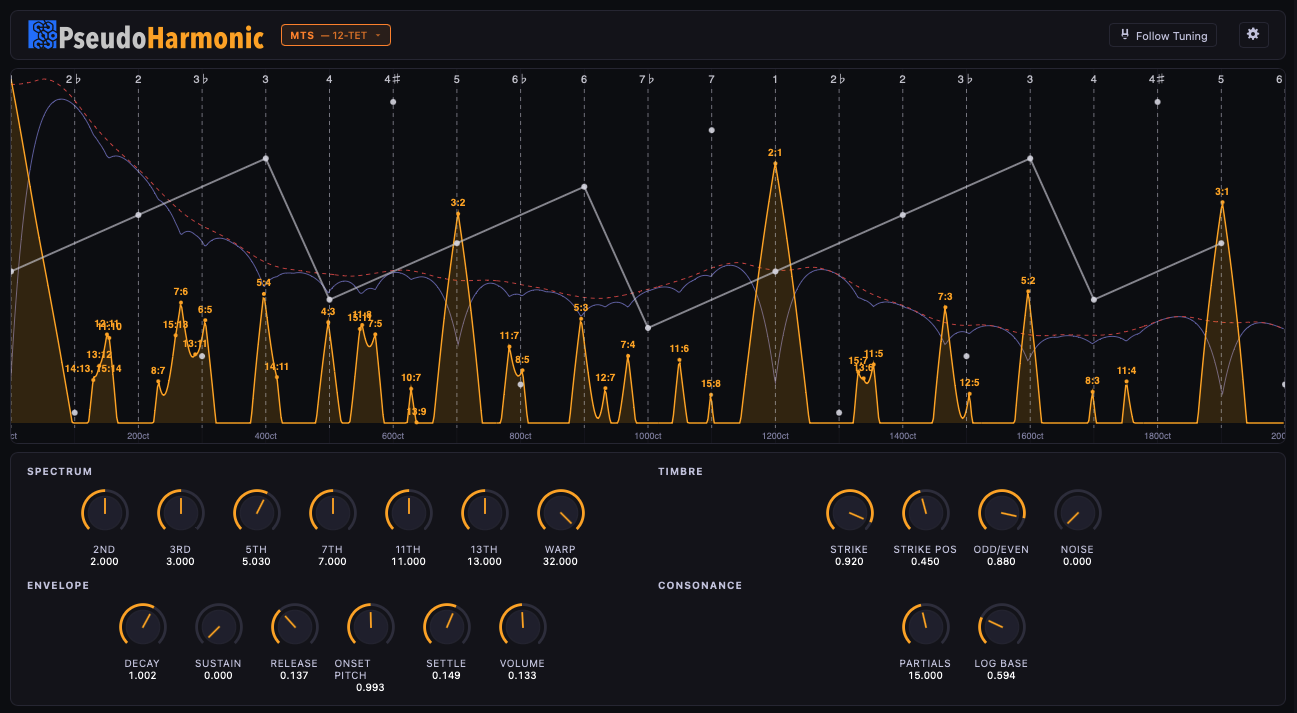
 PseudoHarmonic Synth
Hear the tuning. Additive synthesizer with prime-factor stretching. Real-time consonance curve shows how timbre and tuning interact. "Follow Tuning" to tune overtones automatically making the timbre "fit" the tuning of the MOS in PitchGrid. VST3/AU + standalone.
Download Synth Learn MoreTogether: A Complete System
Change a scale in your DAW — your controller layout updates instantly. Explore 5-note, 8-note, 10-note scales, each with modes and transpositions intact. The familiar clichés of Western music — the patterns that make music feel like music — now work in completely new tonal architectures.
What Still Works
PitchGrid doesn't throw away what you learned. It separates what's truly universal from what's just a side effect of 12-tone equal temperament.
✓ Universal Structure
- Modes and modal interchange
- Keys and key relationships
- Functional tonality
- Voice leading and counterpoint
- Scale degree + accidental notation
↻ The 12-TET Special Case
- Circle of fifths closing after 12 steps (in general, it's a spiral)
- The semitone as fundamental unit
- Conflating "small step" with "chromatic alteration"
- Enharmonic equivalence (C♯ = D♭)
Who Is PitchGrid For?
✓ PitchGrid is for you if:
- You want to understand why Western music theory works the way it does
- You're a composer looking for fresh harmonic territory with real structure
- You want new sounds without abandoning the theory you know
- You play an isomorphic controller and want to explore new tunings
- You've tried microtonality and wished it connected back to tradition
? You might want something else if:
- You want to auto-tune existing recordings
- You're happy managing thousands of individual tuning files
- You're not ready to invest time learning new concepts
Not sure yet? Try it free for 14 days, with full features and no card.
2,500 Years in the Making
PitchGrid doesn't start from zero. It builds on the same foundations as all of Western music — the stacking of fifths that Pythagoras described, the modes that medieval composers sang, the key relationships that Bach exploited and Beethoven expanded.
Everything you already know still works. But now there's room to go further — into scale structures that are mathematically just as coherent as the diatonic, with their own modes, keys, and modulation spaces.
The next chapter of tonal music is waiting to be written. Maybe you'll write it.
Start ExploringPitchGrid for Ableton Move
Turn your Ableton Move into a microtonal groove box. A free MIDI FX module for the Move Everything framework — 190+ tuning presets, real-time pad coloring, and full MPE output.
Watch PitchGrid in action on an Ableton Move
Get It on GitHubMore Tools
Online Tools
Interactive web apps for exploring scales and tuning systems — no install required.
Explore ToolsScale Mapper
Visualize and explore regular scale systems with advanced mapping algorithms.
Open MapperContinuum Bridge
Simon O'Rorke's app that sends PitchGrid tunings to a Haken Continuum. Windows and macOS.
View on GitHubThe Theory Behind It
From Pythagoras to generalized diatonic scales — how 2,500 years of tonal thinking leads naturally to the PitchGrid framework.
Read the Full StoryMusic Created with PitchGrid
Real music using PitchGrid — early examples and releases
- Beats Basteln — "Tranquil 9&5in17"
Album: various releases — Bandcamp - Peter Daly & Simon O'Rorke — "Well-Adjusted"
Duo improvisation — viola and Haken Continuum in Slendric[11] — Bandcamp - Forrest Fang — "Harmonic Perch"
Album: *Radiance and the Receding of Light* (Projekt Records) — Bandcamp - Western Sub — "Unseen footage"
Album: single — SoundCloud - Peter Jung & Lucas Croon — "Primus Kantus"
Single — SoundCloud - Peter Jung — PitchGrid demos & experiments
Playlist: SoundCloud - DEZ — Pianoteq A/B demos (12-TET vs just 3rds and 5ths)
Modartt forum — LISTEN UP ! Or down ...
Videos & Demonstrations
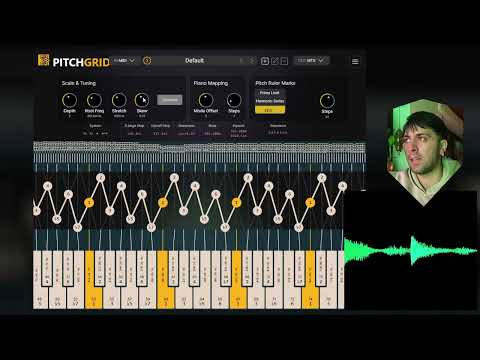
Featured Review: Beats Basteln
"This plugin is insane." — Florian Mrugalla
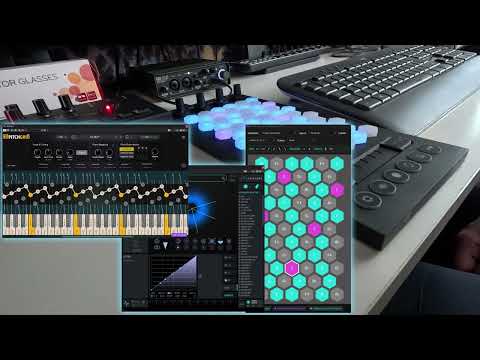
Exquis PitchGrip ZyKlop
User video by Bobox (@Beaubox) — PitchGrid with the Exquis.
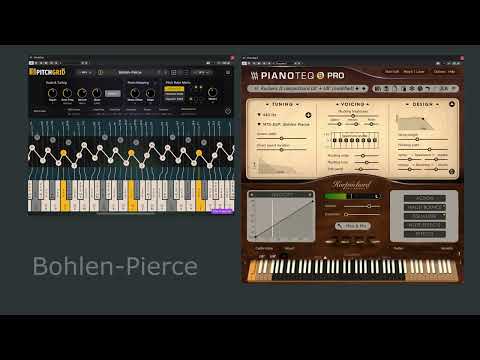
Bohlen Pierce Comp 01
User video by Bobox (@Beaubox) — a Bohlen–Pierce sketch with PitchGrid.
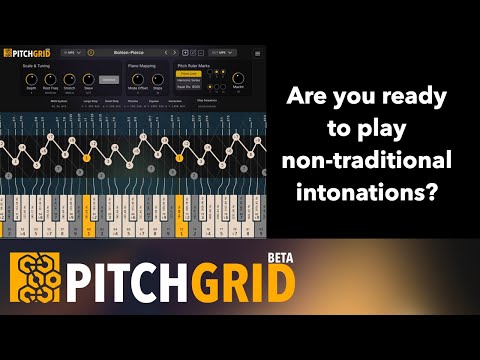
PitchGrid Plugin Introduction
Getting started with the PitchGrid plugin.

Now and Xen Podcast
Episode 093 — in-depth discussion with Stephen Weigel.
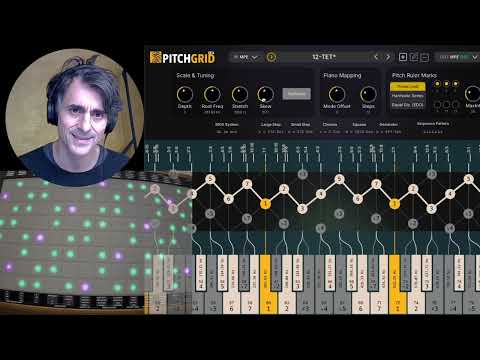
Uncover the Hidden Potential
Exploring new tonal possibilities with PitchGrid.
Events & Exhibitions
PitchGrid Workshop at Untwelving, Munich
"Touch the Microtones" — open PitchGrid workshop at Campus #28 "Untwelving" at the Münchner Kammerspiele, May 23rd, 2026. Participants included people new to microtonality, and some new to music. Workshop results were presented afterwards in the Habibi Kiosk.
ARTE Tracks later covered the convention in Mikrotonale Musik: Revolution der westlichen Musikwelt. PitchGrid appears only as a brief glimpse — not named in the film — but the piece is a good window onto the event.
See ProgramPitchGrid at Superbooth 2026
Visit us at Superbooth 2026 in Berlin, booth o136. Explore alternative tuning systems hands-on.
Learn MoreTalk at Superbooth 2025
"Microtonal Dimensions" with Intuitive Instruments and Entonal Studio. May 9th, 2025.
Watch RecordingOpen Source
Most PitchGrid sources are publicly available on GitHub. Contributions welcome!
PitchGridRack
VCV Rack plugin including the MicroExquis module for hardware integration.
View Repositoryscalatrix
Core library unifying PitchGrid algorithms. Written in C++ with Python and WASM bindings.
View Repositorypseudoharmonic-synth
Additive synth with prime stretches, real-time consonance visualization, OSC "Follow Tuning" for MOS scales from PitchGrid Mapper. Now public with releases.
View RepositoryReferences & Inspiration
PitchGrid is built on the shoulders of giants. Thank you to these pioneers:
- Musical Tonality (2023)
Hans Peter Deutsch's 500+ page mathematical exploration of perfect tonal systems for Western music. - The Wilson Archives
Erv Wilson's discovery of MOS scales and Kraig Grady's popularization of these concepts. - William Sethares
Profound insights on the connection between tuning and the spectrum of sound. - Now and Xen
Stephen Weigel's invaluable podcast on the current state of microtonality.
Hear It for Yourself
Load PitchGrid in front of your favourite synth, pick a preset, turn the knobs.
macOS & Windows · VST3 · AU · CLAP · full features in the trial, no card
Get Involved
Who is behind PitchGrid?
PitchGrid is built by Peter Jung at Bayes GmbH in Cologne.
If you are a builder of tools for musicians and are interested in integrating PitchGrid into your product, or if you'd like to contribute to the project, I would be happy to support you.